

Most polymers do not mix. Blend polypropylene with nylon, or add glass fiber to polypropylene, and you get a coarse, weakly bonded structure that cracks under load. A compatibilizer is the additive that fixes this. This guide explains what a compatibilizer is, how it works at the molecular interface, which types exist, how much to add, and how to choose the right grade for your resin system — with real dosage numbers and formulation examples from our compounding work.
Compatibilizer Definition
In polymer chemistry the process itself is called compatibilization. In practice, the most widely used compatibilizers are maleic anhydride (MAH) grafted polyolefins such as PP-g-MAH, PE-g-MAH, and ABS-g-MAH, together with glycidyl methacrylate (GMA) grafted types for polar resin systems. They are typically dosed at 2–10% of the total formulation.
Why Polymer Blends Need a Compatibilizer
Thermodynamically, almost all polymer pairs are immiscible. When you melt-blend them, the minor phase forms large droplets inside the matrix, and the boundary between the two phases is sharp and weak. Three problems follow:
- Coarse morphology. Large dispersed droplets (often 5–20 µm) act as stress concentrators and initiate cracks.
- Poor interfacial adhesion. Under load the phases pull apart; you see low elongation, low impact strength, and delamination on the part surface.
- Unstable structure. Droplets coalesce during processing and storage, so properties drift from batch to batch.
The same logic applies to filled and reinforced systems. Glass fiber, talc, calcium carbonate, magnesium hydroxide, and wood flour are all polar; polyolefins are non-polar. Without a compatibilizer (often called a coupling agent in this context), the filler is simply embedded, not bonded, and the reinforcement is wasted.

How a Compatibilizer Works: Two Mechanisms
All compatibilizers share one design principle: one part of the molecule is miscible with polymer A, and another part is miscible with — or reacts with — polymer B. That dual affinity drives the molecule to the interface, where it behaves like a molecular bridge. There are two ways this bridge is built.
1. Physical (interfacial) compatibilization
A pre-made block or graft copolymer, for example SEBS in a PP/PS blend, has segments that dissolve into each phase. It does not react chemically; it simply locates at the boundary, reduces interfacial tension, and stabilizes the droplet size. This mechanism is useful when both polymers are non-reactive, but the copolymer must be tailored to each specific blend, which limits flexibility.
2. Reactive compatibilization
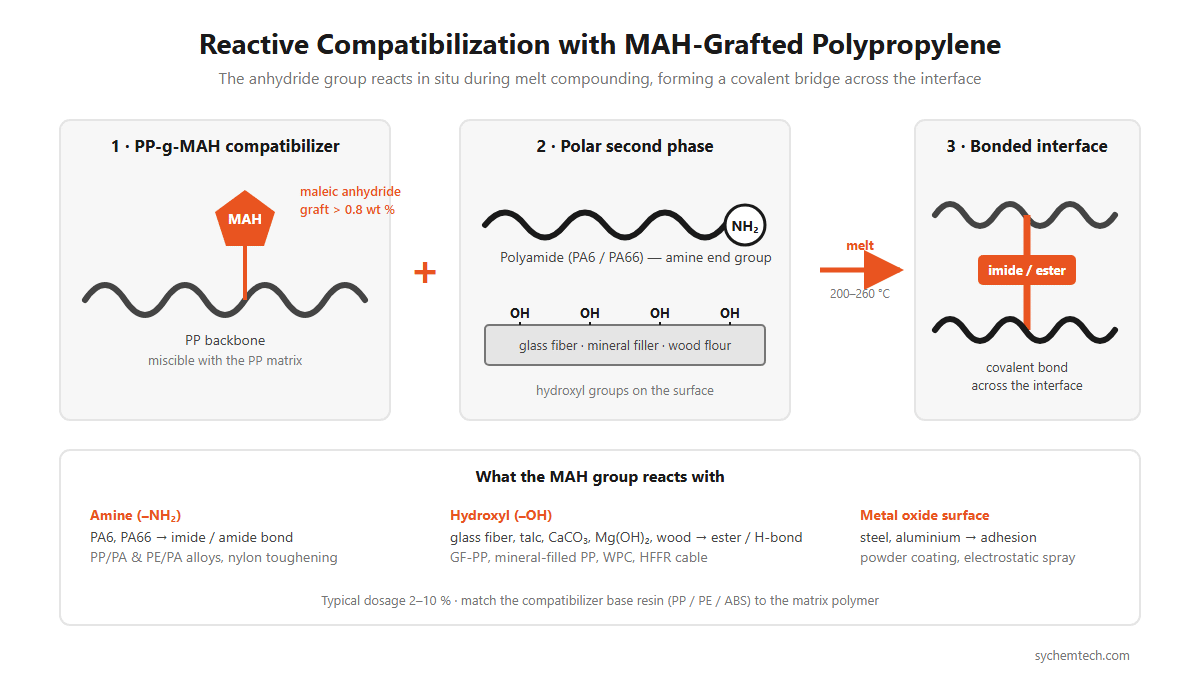
Here the compatibilizer carries a reactive functional group — most commonly maleic anhydride — grafted onto a polyolefin backbone that is fully miscible with the matrix. During melt processing the anhydride group reacts in situ with functional groups on the second phase:
- Amine end groups on polyamide (PA6, PA66) → forms imide/amide bonds. This is how PP-g-MAH and PE-g-MAH compatibilize PP/PA and PE/PA alloys and toughen nylon.
- Hydroxyl groups on glass fiber sizing, mineral fillers, and wood flour → forms ester bonds and strong hydrogen bonding. This is the coupling mechanism in glass-fiber-reinforced PP and wood-plastic composites.
- Metal oxide surfaces → provides adhesion of polyolefin powder coatings and multilayer structures to steel and aluminium.
Because the bond is covalent and formed during compounding, reactive compatibilization is robust, tolerates a wide range of blend ratios, and is the dominant approach in industrial compounding today.
Types of Compatibilizers
The base resin of the compatibilizer must match the matrix polymer, otherwise the grafted chain will not anchor in the continuous phase. The table below summarizes the main industrial families.
| Type | Base resin | Functional group | Typical target systems | Typical dosage |
|---|---|---|---|---|
| PP-g-MAH | Homo- or block PP | Maleic anhydride, >0.8 wt% in high-activity grades | Glass-fiber PP, mineral-filled PP, PP/PA alloys, PP/polar resin blends | 3–5% |
| PE-g-MAH (HDPE base) | HDPE | Maleic anhydride | Wood-plastic composites, rotational moulding powders, electrostatic spray coatings | 2–10% |
| PE-g-MAH (LLDPE / m-LLDPE base) | LLDPE or metallocene LLDPE | Maleic anhydride | PA toughening, PA/PE alloys, halogen-free flame-retardant cable, metal adhesion, asphalt modification | 3–10% |
| ABS-g-MAH | ABS | Maleic anhydride | Glass-fiber ABS, mineral-filled ABS, PC/ABS alloys | 3–5% |
| Maleimide copolymer (ABS type) | Rubber / styrene / acrylonitrile / maleimide | Maleimide | PA/ABS alloys where both toughness and rigidity are needed | 5–10% |
| POE-g-MAH | Polyolefin elastomer | Maleic anhydride | Impact modification of PA and PP where compatibilization and toughening are needed together | 5–15% |
| GMA-grafted types | PE, PP, or elastomer | Glycidyl methacrylate (epoxy) | Polar resins with carboxyl or hydroxyl end groups | 2–8% |
Two parameters matter most when comparing grades within a type: the graft content (how much MAH is attached, which sets reactivity) and the melt flow rate (which must be compatible with your processing window). High-activity grades with MAH above 0.8 wt% let you reach the target performance at lower dosage.
Where Compatibilizers Are Used — With Formulation Examples
Glass-fiber-reinforced polypropylene
The largest single application. A representative formulation is 67% PP + 30% glass fiber + 3% PP-g-MAH. The compatibilizer bonds the fiber sizing to the PP matrix, and tensile strength typically rises by 40–60% compared with the same compound without a coupling agent. Used for automotive under-bonnet parts, washing-machine drums, and structural housings.
Mineral-filled polypropylene
Talc- or calcium-carbonate-filled PP for appliance and furniture parts. 2–4% PP-g-MAH improves filler dispersion, raises flexural modulus, and reduces the whitening that appears when the filler debonds under stress.
Low-VOC automotive interiors
Standard MAH-grafted grades carry residual odor from the grafting process. For dashboard, door-panel, and pillar-trim compounds, use a low-odor PP-g-MAH grade (odor level around 3.0 on the PV 3900 scale) so the compound passes OEM emission specifications without post-treatment.
PC/ABS and PA/ABS alloys
ABS-g-MAH at 3–5% compatibilizes PC/ABS blends for electronics housings. For PA/ABS alloys, a maleimide-type copolymer at 5–10% gives both the toughness of ABS and the rigidity and chemical resistance of nylon.
PA/PE alloys and nylon toughening
LLDPE-based PE-g-MAH at 5–10% reacts with the amine ends of PA6 or PA66. The result is a super-tough nylon with notched impact several times higher than the neat resin, used in power-tool housings and automotive connectors.
Wood-plastic composites and halogen-free cable
In WPC decking, 2–4% HDPE-based PE-g-MAH couples wood flour to the polyethylene matrix and cuts water absorption. In halogen-free flame-retardant cable, where 55–65% magnesium hydroxide or ATH is loaded into polyolefin, 3–6% PE-g-MAH is essential to keep elongation above the 125% typically required by cable standards.
Powder coatings and metal adhesion
HDPE-based PE-g-MAH in electrostatic spray powders gives polyethylene direct adhesion to steel and aluminium for pipe coatings, fence coatings, and dishwasher racks.
How to Select the Right Compatibilizer
Work through these four questions in order:
- What is the continuous phase? Choose the compatibilizer with the same base resin — PP-g-MAH for PP, PE-g-MAH for PE, ABS-g-MAH for ABS. A PP-based grade in a PE matrix will phase-separate and do nothing.
- What is the second phase reacting with? Amine groups (PA) and hydroxyl groups (glass, mineral, wood) respond to MAH. Carboxyl or hydroxyl end groups on polar resins respond to GMA.
- What melt flow does your process need? Injection moulding of thin-wall parts favours high-MFR grades (90–135 g/10 min); extrusion of WPC profiles and cable favours low-MFR grades (0.5–4 g/10 min) for melt strength.
- Any odor, color, or regulatory constraints? Automotive interiors need low-VOC grades; food-contact and medical applications need grades with documented compliance.
Start at the lower end of the recommended dosage range and run a ladder study (for example 2%, 3%, 5%). More is not better — excess compatibilizer that cannot reach the interface stays in the matrix, lowers stiffness, and adds cost without adding performance.
Compatibilizer vs. Toughening Agent — What Is the Difference?
These two additives are often confused because some products do both jobs. A compatibilizer’s primary role is interfacial adhesion; it may improve impact strength as a side effect of better bonding, but that is not its main purpose. A toughening agent is a dispersed elastomer phase (POE, EPDM, or their MAH-grafted versions) whose main role is to absorb impact energy. When you need a large jump in notched impact in nylon or PP, you use a toughening agent; when you need the filler or second polymer to bond, you use a compatibilizer. POE-g-MAH is the classic product that delivers both.
Frequently Asked Questions
How much compatibilizer should I add?
For glass-fiber or mineral-filled PP, 3–5%. For PA/ABS and PA/PE alloys, 5–10%. For wood-plastic composites, 2–4%. For highly filled halogen-free cable compounds, 3–6%. Always confirm with a small dosage ladder on your own equipment.
Is a compatibilizer the same as a coupling agent?
Functionally yes. “Coupling agent” is the term used when the second phase is an inorganic filler or fiber; “compatibilizer” is used for polymer/polymer blends. MAH-grafted polyolefins serve both roles.
Does a compatibilizer improve impact strength?
It improves impact by restoring adhesion between phases, so cracks no longer start at the interface. For a large increase in impact strength you should combine it with, or switch to, an MAH-grafted elastomer such as POE-g-MAH.
What does MAH graft content mean, and is higher always better?
Graft content is the weight percentage of maleic anhydride chemically attached to the polymer backbone. Higher content means more reactive sites and lower required dosage, but grafting is done with peroxide, so very high-graft grades can have lower molecular weight, higher melt flow, and more residual odor. High-activity grades above 0.8 wt% are the usual compromise.
Can I use PP-g-MAH in a polyethylene compound?
No. The polypropylene backbone is not miscible with PE, so the compatibilizer will not anchor in the matrix. Use an HDPE- or LLDPE-based PE-g-MAH instead.
Will a compatibilizer affect odor or VOC?
Standard grades carry some residual odor from the grafting reaction. For automotive interior parts and consumer goods, specify a low-odor, low-VOC grade tested to PV 3900 or a similar OEM method.
Conclusion
A compatibilizer is the difference between a polymer blend or filled compound that looks good on paper and one that performs in the part. By locating at the interface and — in reactive grades — forming covalent bonds during compounding, it turns a weak two-phase system into a bonded, fine-structured material. Match the base resin to your matrix, match the functional group to the second phase, choose the melt flow for your process, and dose in the 2–10% range with a ladder trial.
SYCHEM TECH produces the SY series of MAH-grafted PP, PE, and ABS compatibilizers and, as your formulation development partner, can help you select the right grade and dosage for your specific resin, filler, and processing conditions. Explore the full compatibilizer product range, the parent grafted polymers hub, and our wider functional additives line.
Need help choosing a compatibilizer grade?
Tell us your matrix resin, filler or blend partner, and processing window. We will recommend a grade and arrange samples.
Request Technical Support