SEBS & SBS Thermoplastic Elastomers
High-Performance Styrenic Block Copolymers for Compounding, Adhesives & ModificationProduct Categories
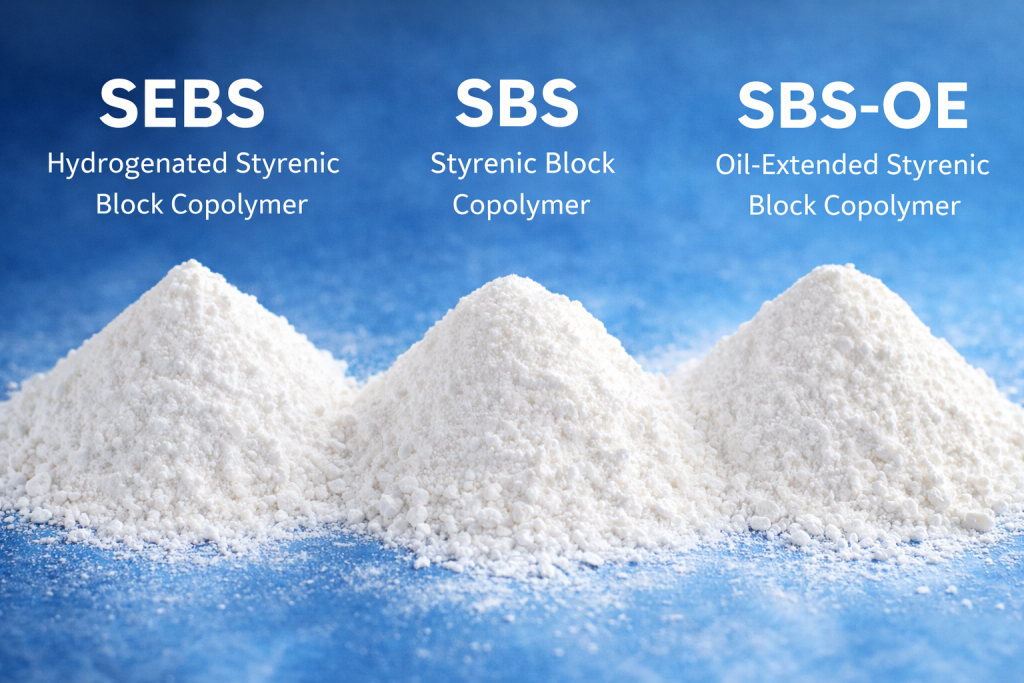
As an SEBS supplier, SYCHEM TECH offers three styrenic elastomer solutions for different performance and cost requirements: SEBS, SBS-OE (oil-extended) and SBS (non-oil-extended).
SEBS – Hydrogenated Styrenic Block Copolymers
SEBS (Styrene Ethylene Butylene Styrene) is a high-performance thermoplastic elastomer offering excellent elasticity, heat resistance, and long-term durability.
Hydrogenated structure provides outstanding resistance to aging, UV, ozone, and oxidation, ensuring stable performance in demanding applications.
Not sure whether SEBS or SBS suits your compound? Compare structure, mechanical properties, processing and applications in our SEBS vs SBS selection guide for buyers. New to SEBS? Start with what is SEBS.
Premium LCY SEBS Solutions
Select the Right Grade for Your Application
7550, 7550U, 9526D, 9550, 9550U, 9557D, 9645D, 9901
7550, 7550U, 7554
7550, 7550U
9526D
7550, 7550U
9557D, 9645D
9550, 9550U, 9551, 9551U, 9552, 9552U, 9645D
9526D
9557D
9552, 9552U
7554U, 9552, 9552U, 9557D
9645D
7550, 7550U, 7554, 7554U, 9526D, 9550, 9550U, 9551, 9551U, 9552, 9552U, 9557D, 9645D, 9901
7533
7551
9901
SBS-OE – Oil-Extended Styrenic Block Copolymers
SBS-OE (Oil-Extended Styrene Butadiene Styrene) is a flexible thermoplastic elastomer containing process oil, designed for soft, resilient, and cost-effective TPE applications.
Oil extension enhances flexibility, rebound, and low-temperature performance, making SBS-OE an ideal material for footwear and foamed products.
Available SBS-OE Grades
Tailored Grades for Every Application Need
1475, 1485, 1487, 1502, 1546
SBS – Styrenic Block Copolymers
SBS (Styrene Butadiene Styrene) is a non-oil-extended thermoplastic elastomer combining the properties of rubber and plastics for versatile performance applications.
It delivers excellent elasticity, rebound, and low-temperature flexibility, while enabling efficient processing without vulcanization.
High-Performance LCY SBS Products
Choose the Perfect Grade for Your Specific Application
3411, 3411C
3412
3780
3520, 3522, 3527, 3536, 3542, 3545, 3546, 3566
3537, 3710, 3741
3411P
3501
SEBS, SBS-OE or SBS: which family do you need?
All three are styrenic block copolymers, so they behave like rubber at room temperature yet process like thermoplastics. The differences come from the rubbery mid-block and the oil content:
| Family | What it is | Best for | Grades |
|---|---|---|---|
| SEBS | Hydrogenated, saturated mid-block | Outdoor, heat-aged and low-odour parts; soft-touch overmoulding; medical; PP modification | LCY SEBS grades |
| SBS-OE | SBS pre-blended with process oil | Soft TPR shoe soles, slippers and mats; faster mixing | SBS-OE grades |
| SBS | Dry, non-oil-extended SBS | Asphalt and roofing, adhesives, compounding where you set your own oil level | LCY SBS grades |
Still deciding between hydrogenated and standard grades? Our SEBS vs SBS selection guide compares weathering, processing temperature, oil uptake and cost per part.
SEBS and SBS FAQ
What is SEBS elastomer?
SEBS (styrene-ethylene-butylene-styrene) is a styrenic block copolymer made by hydrogenating SBS. Hard polystyrene end blocks hold the chains together, and the saturated ethylene-butylene mid-block gives rubber-like elasticity. Because the mid-block has no double bonds, SEBS elastomer resists heat, UV, ozone and oxidation far better than SBS, and it takes up large amounts of paraffinic oil for very soft compounds.
Is SEBS a rubber or a plastic?
Both, which is why it is called a thermoplastic elastomer. At room temperature the polystyrene domains act as physical cross-links, so SEBS stretches and recovers like vulcanized rubber. When heated above about 100 °C those domains soften, and SEBS melts and flows like a plastic. It needs no vulcanization, can be injection molded or extruded on standard plastics equipment, and sprues and scrap can be reground and reused.
What are the main SEBS applications?
Most SEBS goes into TPE compounds with oil and PP: soft-touch grips, handles and overmolded parts on PP, automotive seals and interior parts, hoses and tubing, and other injection-molded components. Other SEBS applications are medical tubing and bags, hot-melt and pressure-sensitive adhesives, sealants, protective film, oil gels and cable filling, and impact modification of PP and PE. For PP toughening, also compare POE elastomers. See the application table on our SEBS grades page.
When is SBS the better choice than SEBS?
SBS thermoplastic elastomer costs less and is the standard choice for asphalt and roofing modification, solvent and hot-melt adhesives, footwear and indoor rubber goods, where UV and heat aging are not critical. Oil-extended SBS-OE is preferred for soft TPR shoe soles. Choose SEBS for outdoor, heat-aged, low-odor or medical parts. Our SEBS vs SBS selection guide shows the trade-offs.
How does SEBS compare with silicone?
SEBS compounds cost less, process on ordinary injection and extrusion lines, bond to PP in two-shot molding and are recyclable. Silicone rubber works over a much wider temperature range and keeps its compression set at high temperature, but it must be cured and cannot be remelted. For parts that stay below roughly 100 °C, SEBS is often the lower-cost option; for heat-resistant seals in engines or repeated steam sterilization, silicone or TPV may fit better. See TPV vs TPE.
Are you an SEBS manufacturer or an SEBS supplier?
SYCHEM TECH is an SEBS supplier based in Shenyang, China, not a producer. We supply hydrogenated SEBS, SBS and SBS-OE grades from established producers and help you match the grade to your compound, adhesive or modification target. Tell us your application and hardness or oil level, and we will email the TDS and arrange a sample. Contact our team or write to info@sychemtech.com.
Contact Your SEBS Supplier for SEBS & SBS Solutions
As your SEBS supplier, we offer selected SEBS, SBS and SBS-OE grades with reliable performance for
adhesives, footwear, plastic modification, medical, and specialty applications.