
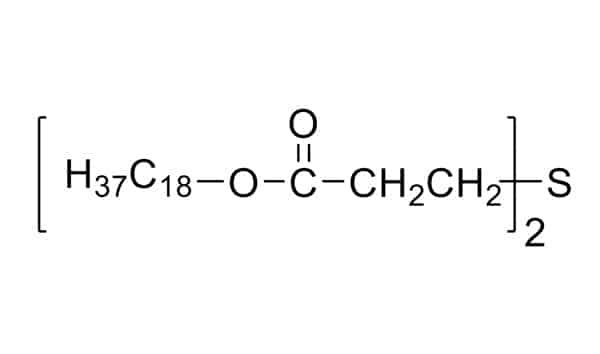
RIANOX DSTP
A sulfur-containing thioester secondary antioxidant that decomposes and neutralizes hydroperoxides formed by auto-oxidation of polymers during processing and long-term use. Provides excellent long-term thermal stability and heat aging resistance. Widely used as a synergist in combination with hindered phenolic primary antioxidants (such as RIANOX® 1010 and RIANOX® 1076) to significantly enhance overall antioxidant performance.
| CAS No. | 693-36-7 |
| Chemical Name | Distearyl thiodipropionate (Dioctadecyl 3,3′-thiodipropanoate) |
| Antioxidant Type | Secondary Antioxidant — Thioester |
| Molecular Weight | 683 |
| Melting Point (°C) | 63–69 |
| Appearance | White Grain / Powder |
| Recommended Dosage | 0.05–1.0% |
| Standard Packaging | 20 kg Bag |
| Solvent | Solubility |
|---|---|
| Chloroform | 20 |
| Methylene Chloride | 13 |
| Toluene | 10 |
| Ethanol | 2 |
| Ethyl Acetate | 2 |
| n-Hexane | 2 |
| Acetone | 1 |
| Methanol | 1 |
| Water | <0.01 |
Polyolefin (PP / PE)
ABS
Polyester (PET / PBT)
Polyamide (PA)
PS / Styrenic Copolymer
Rubber & Elastomer
PVC
Polyurethane (PU)
Adhesive & Sealant
Automotive & Transportation
Packaging
Electronics & Appliances
Agriculture
Building & Construction
Textiles & Apparel
Renewable Energy
Healthcare & Medical
Where RIANOX DSTP fits
RIANOX DSTP (distearyl thiodipropionate, molecular weight 683, melting point 63–69 °C) is a thioester secondary antioxidant. It decomposes the hydroperoxides that build up during years of service at elevated temperature, so it is used for long-term heat ageing rather than for processing. Typical uses:
- PP and PE pipe, under-hood and appliance parts that run hot
- Wire and cable compounds that must pass long-term heat-ageing tests
- ABS and other styrenics
- Polyolefin compounds filled with talc or other minerals
Typical use levels
- Long-term heat ageing: 0.1–0.5%, together with 0.05–0.2% of a phenolic antioxidant
- The recommended range on the grade sheet is 0.05–1.0%
These are starting points. Confirm the level with multiple-pass extrusion (melt flow retention and colour) and oven ageing on your own compound.
Choosing a secondary antioxidant
How RIANOX DSTP compares with the other phosphites and thioesters we supply:
| Grade | Type | Mol. weight | Melting point | Main role |
|---|---|---|---|---|
| RIANOX 168 | Phosphite | 647 | 181–185 °C | Processing stability and colour; hydrolytically stable |
| RIANOX 626 | Diphosphite | 604 | 170–180 °C | High-activity processing stabilizer, colour control |
| RIANOX DSTP | Thioester | 683 | 63–69 °C | Long-term heat ageing synergist |
| RIANOX DLTP | Thioester | 515 | 39.5–42.5 °C | Long-term heat ageing; easier dispersion |
Pairing RIANOX DSTP with a phenolic antioxidant
RIANOX DSTP is a secondary antioxidant: it decomposes hydroperoxides but does not trap free radicals, so it is used together with a hindered phenol such as RIANOX 1010 or RIANOX 1076. Thioesters work best at a phenolic-to-thioester ratio of about 1:2 to 1:3. Add RIANOX 168 for processing stability. Outdoor parts that rely on HALS need a low DSTP level, because its sulfur by-products are acidic and weaken HALS. For outdoor parts, add a HALS light stabilizer; our HALS UV stabilizer guide explains how the additives interact.
TDS, documents and samples
The full TDS, COA and SDS for RIANOX DSTP are sent by email with the quotation, together with the producer’s REACH and food-contact declarations where applicable. Samples are available for qualification trials. Request the TDS and a quote, or compare the full antioxidants and HALS range.


