
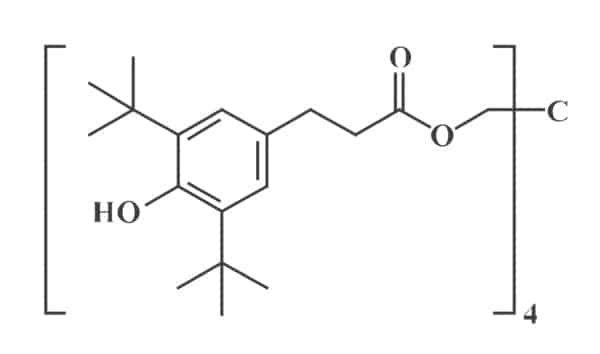
RIANOX 1010
Excellent antioxidant performance with good compatibility with various materials. Typically used in combination with phosphite antioxidants for synergistic stabilization.
| CAS No. | 6683-19-8 |
| Chemical Name | Tetrakis[methylene-3-(3′,5′-di-tert-butyl-4′-hydroxyphenyl)propionate]methane |
| Molecular Weight | 1178 |
| Melting Point (°C) | 110–125 |
| Appearance | White / Off-white Powder |
| Density @20°C (g/cm³) | 1.15 |
| Standard Packaging | 20 kg Paper Bag |
| Solvent | Solubility |
|---|---|
| Acetone | 4T |
| Chloroform | 71 |
| n-Hexane | 0.3 |
| Ethanol | 2 |
| Methanol | 0.4 |
| Ethyl Acetate | 4T |
| Toluene | 60 |
| Water | <0.01 |
| Dichloromethane | C3 |
Automotive & Transportation
Construction
Agriculture
Electronics & Appliances
Packaging
Sports & Leisure
New Energy
Medical & Healthcare
Where RIANOX 1010 fits
RIANOX 1010 is a tetrafunctional hindered phenol with a molecular weight of 1178. The large molecule gives very low volatility and good resistance to extraction, so it keeps protecting the polymer long after processing. That makes it the general-purpose long-term heat stabilizer for most thermoplastics. Typical uses:
- PP and PE pipe, film, fiber and molded parts, together with a phosphite
- ABS, polystyrene and engineering plastics such as polyamide
- Elastomers, hot-melt adhesives and sealants
- Wire and cable insulation that must pass long-term heat-ageing tests
Typical use levels
- Process stabilization of polyolefins: 0.05–0.1%, with one to two times as much RIANOX 168
- Long-term heat ageing (pipe, cable, under-hood parts): 0.1–0.3%, often with a thioester
- Adhesives and elastomers: 0.1–0.5%
These are starting points. Confirm the level with multiple-pass extrusion (melt flow retention and colour) and oven ageing on your own compound.
Choosing a phenolic antioxidant
How RIANOX 1010 compares with the other hindered phenols we supply:
| Grade | Structure | Mol. weight | Melting point | Best known for |
|---|---|---|---|---|
| RIANOX 1010 | Tetrafunctional phenol | 1178 | 110–125 °C | General-purpose long-term heat stability |
| RIANOX 1076 | Monofunctional, C18 chain | 531 | 50–55 °C | Compatibility and low colour in polyolefins |
| RIANOX 3114 | Isocyanurate trisphenol | 784 | 218–223 °C | Very low volatility, extraction resistance |
| RIANOX 1790 | Isocyanurate trisphenol | 700 | 155–165 °C | Low colour and gas-fade resistance; fibers |
| RIANOX 245 | Asymmetric phenol | 587 | 77–81 °C | Styrenics, POM and polyurethane |
Pairing RIANOX 1010 with co-stabilizers
A phenolic antioxidant traps free radicals but does not remove the hydroperoxides formed during melt processing. Pair RIANOX 1010 with RIANOX 168 phosphite for processing stability and colour, and with RIANOX DSTP thioester for long-term heat ageing. For outdoor parts, add a HALS light stabilizer, and keep thioesters low when you do, because their acidic by-products weaken HALS. Our HALS UV stabilizer guide explains why.
TDS, documents and samples
The full TDS, COA and SDS for RIANOX 1010 are sent by email with the quotation, together with the producer’s REACH and food-contact declarations where applicable. Samples are available for qualification trials. Request the TDS and a quote, or compare the full antioxidants and HALS range.


