
RIANOX 1790
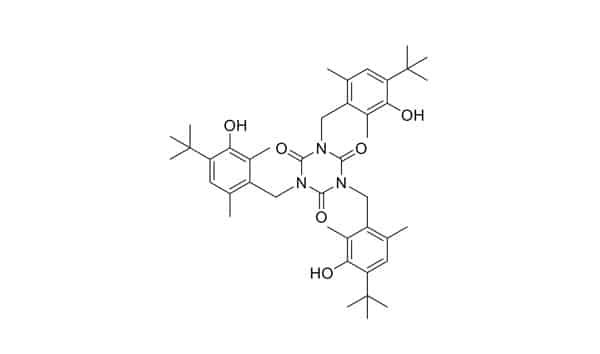
A high performance, sterically hindered phenolic antioxidant of the trisphenol class with a cyanuric acid central moiety. Especially suited for polyurethane, polypropylene, polyester and polyamide fibers at low dosage. Features minimal color contribution, excellent gas-fade resistance, low volatility, and good extraction resistance. Particularly recommended for filled systems in molding applications.
| CAS No. | 40601-76-1 |
| Chemical Name | 1,3,5-Tris(4-tert-butyl-3-hydroxy-2,6-dimethylbenzyl)-1,3,5-triazine-2,4,6(1H,3H,5H)-trione |
| Molecular Weight | 700 |
| Melting Point (°C) | 155–165 |
| Appearance | White Free-flowing Powder |
| Density @20°C (g/cm³) | 1.17 |
| Standard Packaging | 25 kg Carton |
| Solvent | Solubility |
|---|---|
| Acetone | 60 |
| Chloroform | ≥100 |
| Dimethylacetamide | ≥100 |
| Ethyl Acetate | ≥100 |
| Toluene | 75 |
| n-Hexane | 2 |
| Methanol | <0.1 |
| Water | <0.1 |
Polyolefin
Polyamide (PA)
Polyester
Polyurethane (PU)
PVC
ABS / MBS
PS / POM
Elastomer / Rubber
Spandex / Fiber
Automotive & Transportation
Textiles & Apparel
Packaging
Electronics & Appliances
Sports & Leisure
Healthcare & Medical
Building & Construction
Renewable Energy
Where RIANOX 1790 fits
RIANOX 1790 is a trisphenol antioxidant with a cyanuric acid core (molecular weight 700, melting point 155–165 °C). It adds very little colour and resists gas fading, the yellowing caused by nitrogen oxides in warehouses and gas-heated rooms. It also has low volatility and good resistance to extraction, and works at low dosage. Typical uses:
- Polyurethane, including spandex fibers and foams
- PP, polyester and polyamide fibers
- Filled PP molding compounds, for example with talc
- White and light-coloured parts that must not yellow in storage
Typical use levels
- Fibers: 0.05–0.2%
- Polyolefin compounds: 0.05–0.2%, with RIANOX 168
- Polyurethane: 0.1–0.3%
These are starting points. Confirm the level with multiple-pass extrusion (melt flow retention and colour) and oven ageing on your own compound.
Choosing a phenolic antioxidant
How RIANOX 1790 compares with the other hindered phenols we supply:
| Grade | Structure | Mol. weight | Melting point | Best known for |
|---|---|---|---|---|
| RIANOX 1010 | Tetrafunctional phenol | 1178 | 110–125 °C | General-purpose long-term heat stability |
| RIANOX 1076 | Monofunctional, C18 chain | 531 | 50–55 °C | Compatibility and low colour in polyolefins |
| RIANOX 3114 | Isocyanurate trisphenol | 784 | 218–223 °C | Very low volatility, extraction resistance |
| RIANOX 1790 | Isocyanurate trisphenol | 700 | 155–165 °C | Low colour and gas-fade resistance; fibers |
| RIANOX 245 | Asymmetric phenol | 587 | 77–81 °C | Styrenics, POM and polyurethane |
Pairing RIANOX 1790 with co-stabilizers
A phenolic antioxidant traps free radicals but does not remove the hydroperoxides formed during melt processing. Pair RIANOX 1790 with RIANOX 168 phosphite for processing stability and colour, and with RIANOX DSTP thioester for long-term heat ageing. For outdoor parts, add a HALS light stabilizer, and keep thioesters low when you do, because their acidic by-products weaken HALS. Our HALS UV stabilizer guide explains why.
TDS, documents and samples
The full TDS, COA and SDS for RIANOX 1790 are sent by email with the quotation, together with the producer’s REACH and food-contact declarations where applicable. Samples are available for qualification trials. Request the TDS and a quote, or compare the full antioxidants and HALS range.


