
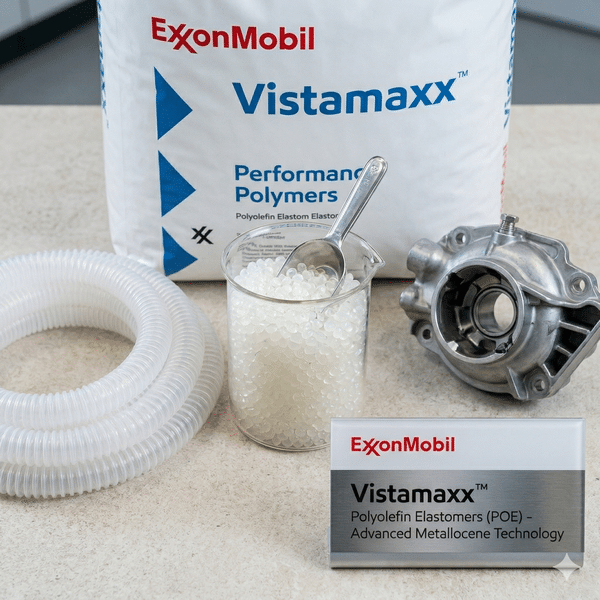
Vistamaxx™ 3000
Vistamaxx™ 3000 is primarily composed of isotactic polypropylene repeat units and randomly distributed ethylene, produced using ExxonMobil’s proprietary metallocene catalyst technology. It has medium elasticity, is easy to process, and is compatible with a wide range of polyolefin blends. It is supplied in free-flowing pellet form.
Key Functions
- Suitable for various film, sheet, and composite applications requiring good durability and mechanical properties.
- Excellent adhesion to conventional or metallocene PP and PE.
- Outstanding elasticity, toughness, and clarity.
- When used as a seal layer in co-extruded structures, the seal initiation temperature is extremely low and seal strength is high.
- Excellent chemical resistance and long-term aging performance.
- RoHS compliant.
| Property | Typical Value | Unit | Test Method |
|---|---|---|---|
| Physical | |||
| Density | 0.873 | g/cm³ | ExxonMobil Method |
| Melt Flow Index (190°C / 2.16 kg) | 3.7 | g/10 min | ExxonMobil Method |
| Thermal | |||
| Vicat Softening Temperature | 149 | °F | ExxonMobil Method |
| Tensile Yield Strength | 760 | PSI | ExxonMobil Method |
Where Vistamaxx™ 3000 fits
Vistamaxx™ 3000 is a propylene-based elastomer: mostly isotactic propylene with randomly distributed ethylene, made with metallocene catalyst. Its propylene sequences co-crystallize with polypropylene, so it blends into PP and adds softness, toughness, clarity and sealability without the coarse phase separation of an ethylene-based elastomer. With a density of 0.873 g/cm³, a melt index of 3.7 g/10 min (190 °C/2.16 kg) and a Vicat softening point of about 65 °C, it belongs to the 3000 series, which keeps more propylene crystallinity, so it suits film, sealing layers and PP modification where some stiffness and heat resistance must remain. Typical uses:
- Seal layers in co-extruded film, for a low seal initiation temperature and high seal strength
- Softening and toughening PP film and sheet while keeping clarity
- Tie and blend layers between PP and PE, thanks to its adhesion to both
Typical use levels
- As a PP film or sheet modifier: 5–25%, depending on the softness and seal temperature you need
- In compounds and TPO: 10–40%, depending on the target flexibility and impact
- As a seal layer or elastic film: up to 100% in that layer
These are starting points. Confirm the level on your own line, checking seal initiation temperature, haze, stiffness and low-temperature impact as relevant.
Vistamaxx grades compared
How Vistamaxx™ 3000 compares with the other Vistamaxx grades we supply:
| Grade | Density (g/cm³) | MI 190 °C/2.16 kg (g/10 min) | Vicat (°C) | Typical use |
|---|---|---|---|---|
| Vistamaxx™ 3000 | 0.873 | 3.7 | 65 | Film and sheet, seal layers, adhesion to PP and PE |
| Vistamaxx™ 3020FL | 0.874 | 1.2 | 67 | Blown film, polymer modification, thermoforming |
| Vistamaxx™ 3980FL | 0.879 | 3.6 | 77 | Film grade with the highest stiffness and heat resistance of the group |
| Vistamaxx™ 6102 | 0.862 | 1.4 | 54 | Most elastic; flexible, clear and impact-modified compounds |
| Vistamaxx™ 6202 | 0.862 | 9.1 | 45 | Higher flow; filled compounds needing good filler dispersion |
Vistamaxx or POE?
Both are metallocene elastomers, but they suit different matrices:
- In PP, Vistamaxx blends in more intimately, so it gives better clarity, sealing and adhesion. Use it when you want a softer, clearer PP film or part.
- For low-temperature impact, an ethylene-octene POE is usually stronger, because its glass transition temperature is lower.
- In PE, an ethylene-based POE is the more compatible choice.
Compare the full ExxonMobil Exact and Vistamaxx range. For glass-fiber or filled PP that also needs adhesion to the filler, see our guide to compatibilizers for PP.
TDS, documents and samples
The full TDS for Vistamaxx™ 3000 is sent by email with the quotation; every shipment comes with a COA, and an SDS and the producer’s REACH and RoHS declarations are available on request. Samples are available for qualification trials. Request the TDS and a quote.
