
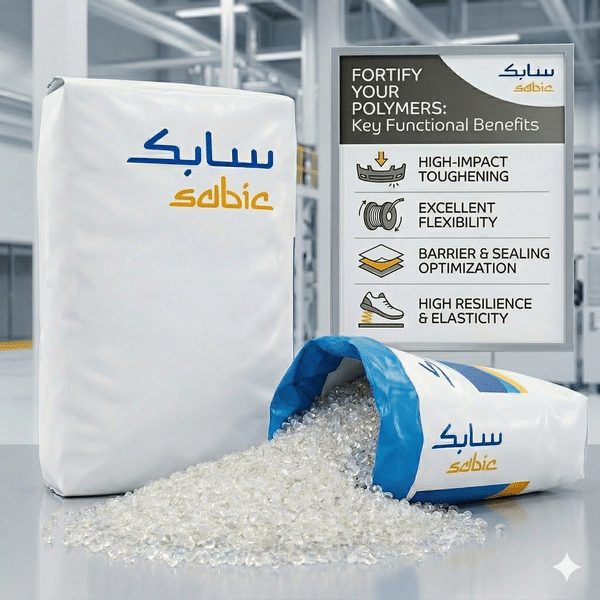
SABIC FORTIFY™ C1055D POE
SABIC® FORTIFY™ POE C1055D is designed as a low-density, high-performance copolymer modifier to provide outstanding impact resistance and flow characteristics.
| Property | Typical Value | Unit | Test Method |
|---|---|---|---|
| Mechanical Properties | |||
| Tensile Properties | |||
| Tensile Strength at Break | 3.1 | MPa | ASTM D638 |
| Elongation at Break | > 1000 | % | ASTM D638 |
| 100% Modulus | 1.4 | MPa | ASTM D638 |
| Durometer Hardness | |||
| Shore A (1 sec) | 55 | – | ASTM D2240 |
| Shore D (1 sec) | 12 | – | ASTM D2240 |
| Flexural Modulus (1% Strain) | 4.4 | MPa | ASTM D790 |
| Tear Strength (Type C) | 27.5 | kN/m | ASTM D624 |
| Polymer Properties | |||
| Density | 857 | kg/m³ | ASTM D792 |
| Melt Flow Rate (MFR) | |||
| At 190°C and 2.16 kg | 1.0 | g/10 min | ASTM D1238 |
| At 230°C and 2.16 kg | 2.2 | g/10 min | ASTM D1238 |
| Mooney Viscosity | |||
| ML1+4, 121°C | 24 | MU | ASTM D1646 |
| Thermal Properties | |||
| Peak Melting Temperature | 37 | °C | Sabic Industrial Method |
| Glass Transition Temperature, Tg | -59 | °C | Sabic Industrial Method |
Where FORTIFY™ C1055D fits
FORTIFY™ C1055D has a typical density of 0.857 g/cm³ and a melt flow rate of 1 g/10 min (190 °C/2.16 kg), which makes it a very soft, low-flow grade in the SABIC FORTIFY range. Grades in this window are typically used for:
- Impact modification of PP and TPO compounds, especially for low-temperature toughness
- Extruded profiles, hoses, and wire and cable compounds
- Foams and soft compounds where melt strength matters
Similar grades from other producers
These grades share the same nominal density (0.857 g/cm³) and melt flow (1 g/10 min): ENGAGE™ 8842, Solumer 851T and Solumer 8605. Comonomer, molecular-weight distribution and additive package still differ, so confirm with a short trial before you switch.
Documents and samples
Every shipment of FORTIFY™ C1055D comes with a TDS and COA; an SDS is available on request, and for applicable grades we can provide the producer’s REACH and RoHS declarations. Samples are available for qualification trials. Compare all SABIC FORTIFY POE grades or the full POE range, and send us your application for a quotation.
